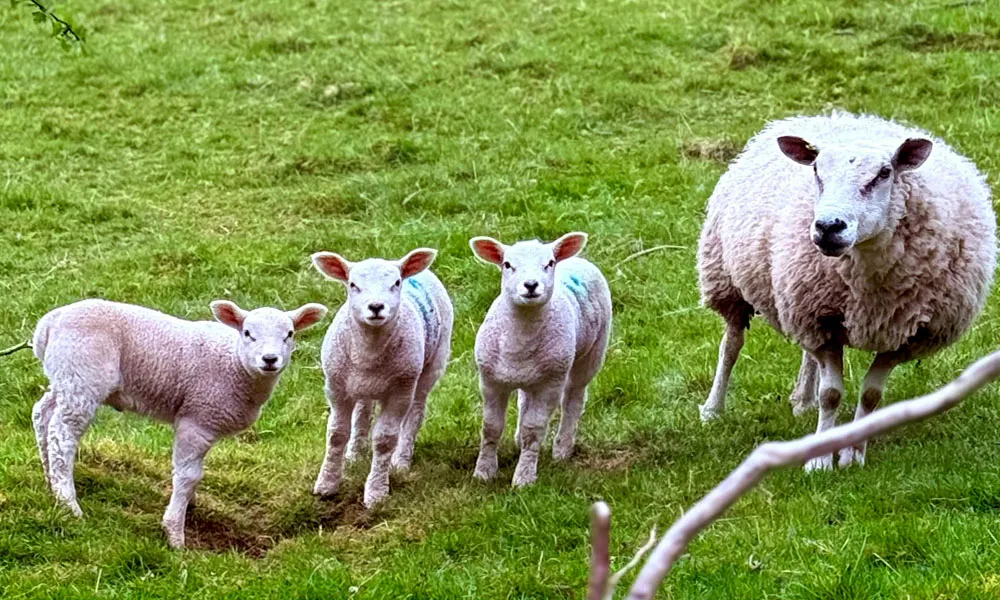
With spring now firmly on the horizon, many lowland sheep farmers will be turning their attention to the coming lambing season. Here at Agridirect.ie, we always stress the importance of good preparation in the run-up to lambing. The well-prepared farmer is far more likely to have a successful and stress-free spring, while lack of planning and preparedness invariably leads to complications and losses.
In this week’s blog entry, we will take a look at some of the most important considerations when preparing for the 2026 lambing season.
Nutrition is essential
The last phase of pregnancy places enormous strain on the ewe’s body. To adequately support her health, it is important that she has an adequate supply of protein and energy to support both herself and the growing lamb, and help her to produce adequate colostrum. If she is not receiving adequate nutrition, her body condition will start to deteriorate. This in turn will create problems at lambing, as she may not be strong enough to deliver a healthy lamb or may be unable to produce the colostrum and milk needed post-labour to sustain the lamb.
Deficiencies are also likely to result in the onset of metabolic diseases like twin lamb disease, which is often fatal.
It is, therefore, extremely important to ensure that your sheep receive adequate feed in the weeks prior to lambing. The amount of feed required should be calculated by determining the quality of available grass and the number of lambs the ewe is expecting. The table below, provided by Teagasc, is a useful guide in this respect and should be consulted when assessing the amount of feed required for each ewe:
|
Weeks Before Lambing |
8 |
7 |
6 |
5 |
4 |
3 |
2 |
1 |
|
Singles |
|
|
0.1kg |
0.2kg |
0.3kg |
0.4kg |
0.5kg |
0.6kg |
|
Twins |
|
0.1kg |
0.2kg |
0.3kg |
0.4kg |
0.5kg |
0.6kg |
0.7kg |
|
Triplets |
0.1kg |
0.2kg |
0.3kg |
0.4kg |
0.5kg |
0.6kg |
0.75kg |
0.9kg |
Remember that hygiene is key
The importance of maintaining good hygiene at lambing time can’t be overstated. Failure to keep lambing pens and all utensils clean and sterilised will inevitably lead to the spread of potentially fatal diseases.
Lambing pens must be cleaned regularly and kept dry. After cleaning, you should scatter lime around the pen and bed with fresh straw. Experts often advise farmers to leave a certain amount of “dry-out” time post cleaning, prior to reintroducing sheep.
It is also essential to maintain good air circulation within pens, as this is a sure way of controlling the spread of disease.
All equipment – including stomach tubes, feeding bottles and lambing ropes – must be sterilised after each use. This can be done by washing in a bucket of sterilising compound, such as Milton. Before sterilising, equipment should be washed thoroughly in a solution of warm water and detergent. The sterilising solution should be changed frequently, in line with the manufacturer’s instructions.
Colostrum, colostrum, colostrum
Without colostrum, lambs will not survive their first few days of life. Each lamb must receive 50ml of ewe colostrum per kilogram of body weight within the first 3 or 4 hours of life, to build immunity to disease. No matter how well you have tended to your flock’s nutrition in the weeks before lambing, there will always be instances when the ewe simply fails to produce enough colostrum. For this reason, you should maintain a store of replacement colostrum powder, which can be used in case of emergency.
However, real ewe colostrum is preferable and it is a good idea to freeze some in Ziplock bags whenever you find a ewe that has an excess of the stuff. The frozen colostrum can be warmed by placing the freezer bag in warm (not boiling) water.
Checklist
The checklist below, provided by Teagasc, is a great resource for helping you prepare for the difficult days ahead:
· Iodine
· Syringes
· Needles
· Glucose
· Bottles
· Teats
Best of luck to all farmers for the days and weeks ahead, from all of us here at Agridirect.ie.