
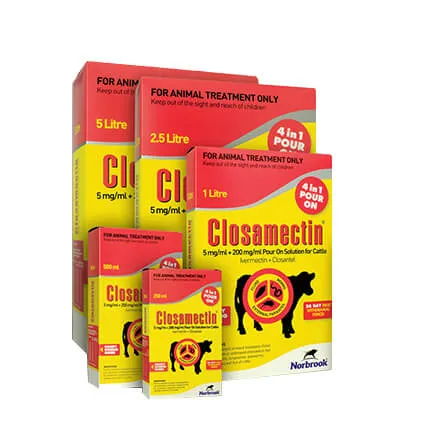
Closamectin 5 mg/ml + 200 mg/ml Pour-On for Cattle
Closamectin Pour-On Solution for Cattle is a ready-to-use, broad-spectrum antiparasitic treatment containing ivermectin 5 mg/ml and closantel 200 mg/ml. It is used to treat and control mixed infestations involving gastrointestinal roundworms, lungworms, adult and late immature liver fluke, eyeworms, warbles, lice and mange mites in cattle.
Combining two active ingredients in one convenient pour-on treatment, Closamectin provides farmers with a practical way to treat susceptible internal and external parasites without injections or oral drenching. With activity against mature liver fluke and late immature fluke from approximately seven weeks after infection, it can form part of a farm-specific parasite-control programme for beef and suckler cattle.
Product Information
| Closamectin Pour-On Product Details | |
|---|---|
| Active Ingredients | Ivermectin 5 mg/ml and Closantel 200 mg/ml (as closantel sodium) |
| Target Species | Cattle |
| Treats and Controls | Gastrointestinal roundworms, lungworms, adult and late immature liver fluke, eyeworms, warbles, lice and mange mites |
| Administration Method | Topical pour-on along the backline |
| Available Sizes | 1L, 2.5L and 5L |
| Dosage | 1 ml per 10 kg bodyweight |
Withdrawal Periods
| Species | Meat & Offal | Milk Withdrawal |
|---|---|---|
| Cattle | 58 days | Not authorised for cattle producing milk for human consumption, including during the dry period |
Important: Cattle must not be slaughtered for human consumption until 58 days after treatment. Do not use in cattle producing milk for human consumption, including during the dry period. Do not use during the second half of pregnancy in heifers intended to produce milk for human consumption.
Due to the risk of cross-contamination through licking, all animals in a group should be treated at the same time. Treated cattle must be kept separate from untreated cattle throughout the withdrawal period.
What Does Closamectin Pour-On Treat?
Closamectin is used for the treatment of mixed fluke, worm and external parasite infestations in cattle. Its combination of ivermectin and closantel provides activity against the following susceptible parasites.
Cattle - Parasites Treated and Controlled
- Gastrointestinal Roundworms: Ostertagia ostertagi (including inhibited larvae), Haemonchus placei, Trichostrongylus axei, Trichostrongylus colubriformis, Cooperia species and Oesophagostomum radiatum (adults and fourth-stage larvae).
- Additional Roundworms: Adult Nematodirus helvetianus and Strongyloides papillosus.
- Lungworms: Dictyocaulus viviparus (adults and fourth-stage larvae).
- Adult and Late Immature Liver Fluke: Fasciola hepatica and Fasciola gigantica.
- Eyeworms: Adult Thelazia species.
- Warbles: Hypoderma bovis and Hypoderma lineatum (parasitic stages).
- Lice: Linognathus vituli, Haematopinus eurysternus and Damalinia bovis.
- Mange Mites: Chorioptes bovis and Sarcoptes scabiei var. bovis.
Liver Fluke Treatment
Closamectin contains closantel, which provides activity against adult and late immature liver fluke. The supplied datasheet reports the following efficacy:
- Mature Liver Fluke: Greater than 95% efficacy against fluke approximately 12 weeks after infection.
- Late Immature Liver Fluke: Greater than 95% efficacy against fluke approximately 7 weeks after infection.
Important: Closamectin should not be assumed to treat all early immature stages of liver fluke. Treatment selection should reflect the age of infection and veterinary advice.
Key Features of Closamectin Pour-On
- Dual Active Ingredients: Combines ivermectin and closantel for the treatment of susceptible internal and external parasites.
- Fluke and Worm Treatment: Treats adult and late immature liver fluke alongside specified gastrointestinal roundworms and lungworms.
- External Parasite Control: Also treats specified lice, mange mites, warbles and eyeworms.
- Ready-to-Use Pour-On: Applied along the backline without oral drenching or injection.
- Adult Liver Fluke Treatment: Greater than 95% efficacy against mature liver fluke at approximately 12 weeks after infection.
- Late Immature Fluke Activity: Greater than 95% efficacy against fluke at approximately seven weeks after infection.
- Single Dosage Rate: 1 ml per 10 kg bodyweight.
- Multiple Pack Sizes: Available in 1L, 2.5L and 5L sizes.
Closamectin Pour-On Dosage for Cattle
Recommended Dose: 1 ml per 10 kg bodyweight, equivalent to 500 micrograms ivermectin and 20 mg closantel per kg bodyweight.
Apply as a single topical treatment in a narrow strip along the midline of the back, between the withers and the tailhead. Cattle should be weighed and grouped according to bodyweight to avoid underdosing or overdosing.
Cattle - Dose and Bottle Coverage
| Weight | Dose | 1L | 2.5L | 5L |
|---|---|---|---|---|
| 50 kg | 5 ml | 200 | 500 | 1000 |
| 100 kg | 10 ml | 100 | 250 | 500 |
| 150 kg | 15 ml | 66 | 166 | 333 |
| 200 kg | 20 ml | 50 | 125 | 250 |
| 250 kg | 25 ml | 40 | 100 | 200 |
| 300 kg | 30 ml | 33 | 83 | 166 |
| 350 kg | 35 ml | 28 | 71 | 142 |
| 400 kg | 40 ml | 25 | 62 | 125 |
| 450 kg | 45 ml | 22 | 55 | 111 |
| 500 kg | 50 ml | 20 | 50 | 100 |
| 550 kg | 55 ml | 18 | 45 | 90 |
| 600 kg | 60 ml | 16 | 41 | 83 |
Bottle Coverage: The 1L, 2.5L and 5L columns show the number of complete doses available at the stated bodyweight, calculated from the dose volume and rounded down to whole doses. Figures assume no product wastage.
Administration Instructions
- External Use Only: Apply topically to cattle using appropriate pour-on dosing equipment.
- Correct Application: Apply in a narrow strip along the midline of the back from the withers to the tailhead.
- Accurate Bodyweight: Weigh cattle as accurately as possible before treatment.
- Correct Dose: Administer 1 ml per 10 kg bodyweight.
- Group Dosing: Group cattle according to bodyweight and dose appropriately to avoid underdosing or overdosing.
- Equipment Calibration: Check dosing equipment to ensure the correct amount is delivered.
- Skin Condition: Do not apply to skin affected by mange, scabs or other lesions, or areas contaminated with mud or manure.
- Rainfall: The effect of rain during or after application has not been investigated. Keep cattle indoors or under cover following treatment when rain is occurring or expected.
- Avoid Clipping: Do not clip cattle immediately before treatment, as this may increase product absorption or the risk of oral ingestion during grooming.
- Prevent Cross-Contamination: Treat all cattle in a group at the same time and keep treated animals separate from untreated animals throughout the withdrawal period.
- Veterinary Guidance: Treatment timing should be based on farm-specific parasite risk and established with a veterinary professional.
Important Safety Information
- Target Species: For cattle only.
- Hypersensitivity: Do not use in animals with known hypersensitivity to ivermectin, closantel or any other ingredients.
- Milk Restriction: Not authorised for cattle producing milk for human consumption, including during the dry period.
- Pregnancy: May be administered during pregnancy where the milk is not intended for human consumption. Do not use during the second half of pregnancy in heifers intended to produce milk for human consumption.
- Cross-Contamination: All cattle in a group should be treated at the same time. Keep treated and untreated animals separate throughout the withdrawal period to prevent transfer through licking.
- Warble Treatment: Seek veterinary advice on treatment timing where Hypoderma larvae may be located near the oesophagus or spinal canal.
- Overdosing: Excessive exposure may cause toxicity, including incoordination, visual impairment or blindness. Avoid overdosing, accidental spillage and oral ingestion.
- Low Nutritional Status: Take additional care when treating cattle in poor nutritional condition, as susceptibility to adverse effects may be increased.
- Anthelmintic Resistance: Repeated use or underdosing can contribute to resistance. Resistance to ivermectin has been reported in Ostertagia ostertagi and Cooperia species in cattle.
- Adverse Reactions: Very rare neurological signs, including ataxia, blindness and recumbency, gastrointestinal signs such as loss of appetite and diarrhoea, and death in extreme cases have been reported.
- Other Species: Avermectins may cause serious or fatal reactions in certain dogs, particularly Collies, Old English Sheepdogs and related breeds, and in turtles and tortoises.
- Protective Clothing: Wear nitrile rubber gloves, boots and a waterproof coat during application.
- Skin and Eye Contact: Avoid direct contact. Wash accidental skin exposure with soap and water. Flush eyes immediately with water and seek medical attention.
- Accidental Ingestion: Seek immediate medical advice and show the product leaflet.
- After Handling: Wash hands thoroughly. Do not eat, drink or smoke while handling the product.
Closamectin Treatment and Parasite Control
The timing of Closamectin treatment should be based on parasite exposure, grazing conditions, herd history and veterinary advice. A farm-specific parasite-control programme can help farmers select appropriate treatment times while reducing unnecessary anthelmintic use.
Housing
Housing provides an opportunity to assess cattle for liver fluke and worm burdens. Whether treatment is required depends on grazing history, parasite exposure and the stage of infection. Veterinary advice should guide treatment selection and timing.
Turnout and Grazing
During the grazing season, cattle may be exposed to gastrointestinal roundworms and liver fluke. Treatment decisions should consider pasture contamination, local parasite risk and diagnostic results where available.
Outwintered Cattle
Cattle grazing outdoors during autumn and winter may remain exposed to liver fluke, particularly on wet or poorly drained land. Treatment requirements should be assessed according to local conditions and veterinary guidance.
Bought-In Cattle
Newly purchased cattle should be managed according to an appropriate quarantine and parasite-control plan. Treatment decisions should consider the animals' history and the risk of introducing resistant parasites into the herd.
Important: There is no single treatment schedule suitable for every farm. The supplied datasheet advises that treatment timing should be customised to individual farm conditions and established by a veterinary professional.
How Cattle Contract Liver Fluke
Cattle can become infected with liver fluke by ingesting infective larvae while grazing contaminated pasture. The liver fluke life cycle involves a freshwater snail intermediate host, making wet and poorly drained grazing areas particularly suitable for infection.
In Ireland, liver fluke risk varies according to rainfall, temperature, drainage, grazing conditions and individual farm history. Farmers should consider local parasite forecasts and veterinary advice when planning fluke-control programmes.
Important: Closamectin is indicated for adult and late immature liver fluke. It should not be assumed to treat every early immature stage of liver fluke.
Environmental Precautions
- Water Protection: Treated cattle must not have direct access to ponds, streams or ditches for 14 days after treatment.
- Aquatic Toxicity: Closamectin is very toxic to aquatic organisms and dung insects.
- Repeated Treatment: Repeated treatments on the same pasture during a grazing season should only be carried out on veterinary advice.
- Avoid Contamination: Do not allow the product or used containers to contaminate surface water, waterways or ditches.
- Disposal: Use appropriate veterinary medicine take-back schemes or approved disposal systems. Do not dispose of unused medicine through wastewater.
Storage and Shelf Life
- Shelf Life: 18 months when packaged for sale.
- Storage Temperature: Do not store above 25°C.
- Container Storage: Store upright in the original container.
- Light Protection: Protect from light.
- Cold Conditions: The solution may become cloudy when stored below 0°C. Allowing it to warm to room temperature restores its normal appearance without affecting efficacy.
- Flammable: Keep away from heat, sparks, open flames and other ignition sources.
- Pack Sizes: Available at Agridirect in 1L, 2.5L and 5L sizes.
- Marketing Authorisation Holder: Norbrook Laboratories Limited.
- Classification: Veterinary medicinal product subject to prescription.
Important: Always read the current product label and all enclosed information for Closamectin 5 mg/ml + 200 mg/ml Pour-On Solution for Cattle before administering to animals. Follow veterinary advice, administer the correct dose and observe the specified withdrawal periods.
Click here to Download Data Sheet
Summary of Product Characteristics
1 NAME OF THE VETERINARY MEDICINAL PRODUCT
Closamectin Pour-On Solution for Cattle.
2 QUALITATIVE AND QUANTITATIVE COMPOSITION
Active ingredient(s)
Ivermectin 5 mg/mL
Closantel (as closantel sodium) 200 mg/mL
Excipients
Brilliant Blue FCF (E133) 0.1 mg/mL
For a full list of excipients see section 6.1.
3 PHARMACEUTICAL FORM
Pour-On solution.
A clear blue/green solution.
4 CLINICAL PARTICULARS
4.1 Target Species
Cattle.
Active ingredient(s)
Ivermectin 5 mg/mL
Closantel (as closantel sodium) 200 mg/mL
Excipients
Brilliant Blue FCF (E133) 0.1 mg/mL
For a full list of excipients see section 6.1.
4.2 Indications for use, specifying the target species
For the treatment of mixed trematode (fluke) and nematode or arthropod infestations due to roundworms, lungworms, eyeworms, warbles, mites and lice of cattle.
Gastrointestinal roundworms (adults and fourth stage larvae)
Ostertagia ostertagi (including inhibited O. ostertagi),
Haemonchus placei,
Trichostrongylus axei,
Trichostrongylus colubriformis,
Cooperia spp,
Oesophagostomum radiatum,
Nematodirus helvetianus (adult),
Strongyloides papillosus (adult).
Lungworms (adult and fourth stage larvae)
Dictyocaulus viviparus
Trematodes (adult and late immatures)
Fasciola gigantica
Fasciola hepatica
Treatment of fluke at 12 weeks (mature) >95% efficacy.
Treatment of fluke at 7 weeks (late immature) >95% efficacy.
Eyeworms (adult)
Thelazia spp
Cattle grubs (parasitic stages)
Hypoderma bovis,
Hypoderma lineatum
Lice
Linognathus vituli,
Haematopinus eurysternus,
Damalinia bovis
Mange Mites
Chorioptes bovis,
Sarcoptes scabiei var bovis
4.3 Contraindications
Do not use in cases of known hypersensitivity to the active substances.
Do not apply to areas of skin which have mange, scabs or other lesions or to areas contaminated with mud or manure.
Avermectins may not be well tolerated in non-target species (cases of intolerance with fatal outcome are reported in dogs – especially Collies, Old English Sheepdogs and related breeds or crosses, and also in turtles/tortoises).
4.4 Special warnings for each target species
Care should be taken to avoid the following practices because they increase the risk of development of resistance and could ultimately result in ineffective therapy.
- Too frequent and repeated use of anthelmintics from the same class, over an extended period of time.
- Underdosing which may be due to underestimation of bodyweight, misadministration of the product, or lack of calibration of the dosing device.
The effect of rain on the pour-on formulation at the time of and after application has not been investigated. For maximum effect animals should be kept indoors or undercover following treatment, when there is rain or an imminent risk of rain.
Suspected clinical cases of resistance to anthelmintics should be further investigated using appropriate tests (e.g., Faecal Egg Count Reduction Test). Where the results of the tests strongly suggest resistance to a particular anthelmintic, an anthelmintic belonging to another pharmacological class and having a different mode of action should be used.
Resistance to ivermectin has been reported in Cooperia spp in cattle.
Therefore the use of this product should be based on local epidemiological information about the susceptibility of the Cooperia spp and recommendations on how to limit further selection for resistance to anthelmintics.
4.5 Special precautions for use
(i)Special precautions for use in animals:
None
(ii)Special precautions to be taken by the person administering the veterinary medicinal product to animals:
The veterinary medicinal product may be irritating to human skin and eyes and the user should be careful not to apply it to himself or other persons.
Operators should wear nitrile rubber gloves and boots with a waterproof coat when applying the product.
Protective clothing should be washed after use. If accidental skin contact occurs, wash the affected area immediately with soap and water.
If accidental eye exposure occurs, flush the eyes immediately with water and get medical attention.
Do not smoke or eat whilst handling the product. Wash hands after use. Use only in well ventilated areas or outdoors.
(iii)Other Precautions Regarding the Environment.
Treated cattle should not have direct access to ponds, streams or ditches for 14 days after treatment.
4.6 Adverse reactions (frequency and seriousness)
Undesirable effects are not expected when the product is used at the recommended dose rate
4.7 Use during pregnancy, lactation or lay
The product is safe for use during pregnancy and lactation.
However, the product is not permitted for use in animals
producing milk for human consumption, including pregnant animals intended to produce milk for human consumption.
4.8 Interaction with other medicinal products and other forms of interaction
None known.
4.9 Amounts to be administered and administration route
The veterinary medicinal product should be administered topically at a dosage rate of 500μg ivermectin per kg bodyweight and 20 mg closantel per kg bodyweight (1 mL per 10 kg).
The formulation should be applied along the midline of the back in a narrow strip between the withers and the tail head.
Assess bodyweight carefully prior to administration.
The timing for treatment should be based on epidemiological factors and should be customised for each individual farm.
A dosing programme should be established by a veterinary professional.
* Dose rate 1 ml per 10 kg bodyweight
4.10 Overdose (symptoms, emergency procedures, antidotes), if necessary
At doses of three times the recommended dose, no significant clinical signs were recorded.
Ivermectin
No antidote has been identified. Symptomatic treatment may be beneficial.
Closantel
like other salicylanilides is a potent uncoupler of oxidative phosphorylation and the safety index is not as high as is the case of many other anthelmintics.
However where used as directed there are unlikely to be any untoward effects.
Signs of overdosage can include
slight loss of appetite,
loose faeces,
decreased vision and
increased frequency of defecation.
High doses may cause
blindness,
hyperventilation,
general weakness and inco-ordination,
hyperthermia,
convulsions,
tachycardia and
in extreme cases death.
Treatment of overdosage is symptomatic as no antidote has been identified.
4.11 Withdrawal Period(s)
Cattle must not be treated within 28 days of slaughter for human consumption.
Not permitted for use in animals producing milk for human consumption, including pregnant animals intended to
produce milk for human consumption.
5 PHARMACOLOGICAL or IMMUNOLOGICAL PROPERTIES
ATC Vet Code:
QP54AA51
Pharmacotherapeutic Group:
Ivermectin, combinations.
| Bodyweight | Dose Volume | 250 ml | 500 ml | 1 Litre | 2.5 Litres | 5 Litres |
|---|---|---|---|---|---|---|
| 100 kg | 10 ml | 25 | 50 | 100 | 250 | 500 |
| 150 kg | 15 ml | 16 | 33 | 66 | 166 | 333 |
| 200 kg | 20 ml | 12 | 25 | 50 | 125 | 250 |
| 250 kg | 25 ml | 10 | 20 | 40 | ||
| 300 kg | 30 ml | 8 | 16 | 33 | 83 | 166 |
| 350 kg | 35 ml | 7 | 14 | 28 | 71 | 142 |
| 400 kg | 40 ml | 6 | 12 | 25 | 62 | 125 |
| 450 kg | 45 ml | 5 | 11 | 22 | 55 | 111 |
| 500 kg | 50 ml | 5 | 10 | 20 | 50 | 100 |
| 550 kg | 55 ml | 4 | 9 | 18 | 45 | 90 |
5.1 Pharmacodynamic properties
Ivermectin is an endectocide with activity against a wide range of internal and external parasites.
Ivermectin is a macrocylic lactone and acts by inhibiting nerve impulses.
It binds selectively and with high affinity to glutamate-gated chloride ion channels which occur in invertebrate nerve and muscle cells.
This leads to an increase in the permeability of the cell membrane to chloride ions with hyperpolarization of the nerve or muscle cell, resulting in paralysis and death of the relevant parasites.
Compounds of this class may also interact with other ligand-gated chloride channels, such as those gated by the neurotransmitter gammaaminobutyric acid (GABA).
The margin of safety for compounds of this class is attributable to the fact that mammals do not have glutamate-gated chloride channels.
The macrocylic lactones have a low affinity for other mammalian ligand-gated chloride channels and they do not readily cross the blood-brain barrier.
Closantel is a member of the salicylanilide class of anthelmintics. Salicylanilides are hydrogen (proton) ionophores (referred to as oxidative phosphorylase uncouplers.)
The chemical structure of salicylanilides illustrate the possession of a detachable proton. This type of molecule is lipophilic and is known to shuttle protons across membranes, in particular the inner mitochondrial membrane. Closantel acts by uncoupling oxidative phosphorylation.
Closantel is a parasiticide with flukicide activity and efficacy against certain other helminths and arthropods.
5.2 Pharmacokinetic properties
After topical administration of Closamectin Pour-On to cattle at a dose rate of 500 microgram ivermectin per kg and 20 mg closantel per kg the following parameters were observed:
Ivermectin – Cmax of 19.13 ng/mL and AUC of 2440 ng.hr/mL;
Closantel – Cmax of 68.5 microgram/mL and AUC of 35207 microgram.hr/mL.
Ivermectin is only partially metabolised. In cattle, only about 1 to 2% is excreted in the urine the remainder is excreted in the faeces, approximately 60% of which is excreted as unaltered drug. The remainder is excreted as metabolites or degradation products. Salicylanilides are poorly metabolised and are excreted mainly unchanged. About 90% of closantel is excreted unchanged in the faeces and urine in cattle.
6 PHARMACEUTICAL PARTICULARS
6.1 List of excipients
Brilliant Blue FCF (E133) Dye
Anhydrous Ethanol
Macrogol,
Cetearyl Ethylhexanoate
Isopropyl Myristate
Povidone
Denatonium Benzoate
Trolamine
Isopropylalcohol
6.2 Incompatibilities
None known.
6.3 Shelf-life
Shelf-life of the veterinary medicinal product as packaged for sale: 1 year.
6.4 Special precautions for storage
Do not store above 25°C.
Store upright in original container.
Protect from light.
Discard unused material. Avoid introduction of contamination.
If stored at temperatures below 0°C, Closamectin Pour-On Solution for Cattle may appear cloudy. Allowing to warm at room temperature will restore the normal appearance without affecting efficacy.
Flammable – keep away from heat, sparks, open flame or other sources of ignition.
6.5 Nature and composition of immediate packaging
Translucent 250 mL and 1L HDPE containers with white HDPE caps and
white 1L, 2.5L and 5L HDPE backpacks with white polypropylene screw caps.
Not all packs sizes may be marketed.
6.6 Special precautions for the disposal of unused veterinary medicinal products or waste materials
EXTREMELY DANGEROUS TO FISH AND AQUATIC LIFE.
Do not contaminate surface waters or ditches with
the product or used container.
Any unused product or waste material should be disposed of in accordance with national requirements.
7 MARKETING AUTHORISATION HOLDER
Norbrook Laboratories Limited
Station Works
Camlough Road
Newry
Co Down,
BT35 6JP
Northern Ireland
8 MARKETING AUTHORISATION NUMBER(S)
VPA 10999/124/001
9 DATE OF THE FIRST AUTHORISATION/RENEWAL OF THE AUTHORISATION
7th August 2009
10 DATE OF REVISION OF THE TEXT
5th May 2010
Closamectin Pour-on for cattle is a ready to use pour-on solution that is used in the treatment and control of mixed trematode (fluke) and nematode or arthropod infestations due to roundworms, lungworms, eye worms, warbles, mites and lice.
Active Ingredient: Ivermectin, Closantle
Target Species: Cattle
Treats and Controls: Gastro-intestinal worm, lungworm,eye worms, warbles, lice, mange mites, immature and mature fluke
Withdrawal Time: 58 days for cattle intended for meat and offal, not suitable for cattle producing milk for human consumption.
Legal Status: POM
Delivery Information
- Fast Nationwide Delivery (Ireland)
- Standard Delivery - orders under €129 are €6.99
- Free Shipping for orders over €129
- Typically 2-4 days for delivery
Note: Some products may have an extra heavy/bulk delivery charge; this will be noted on the product page.
Delivery Service
Here at Agridirect we have joined forces with An Post & DPD to ensure all packages are delivered promptly and safely to you. We ship to all mainland countries within the EU. Deliveries take place Monday to Friday, excluding bank holidays. Once your order has been dispatched from our warehouse, you will be notified by email. If there is a delay with your order for any reason, you will be contacted immediately.
Delivery Times
- Ireland (ROI & NI) - 2-4 Working Days
- EU (Mainland Only) - 4-6 Working Days
Some products have an extended delivery time, this is noted on the products.
Delivery Rates
- Country - Delivery Charge
- Ireland (ROI & NI) - €6.99
- Austria - €39.99
- Belgium - €36.99
- Czech Republic - €39.99
- Denmark - €39.99
- Finland - €51.99
- France - €36.99
- Germany - €36.99
- Hungary - €43.99
- Italy - €49.99
- Luxembourg - €36.99
- Netherlands - €36.99
- Poland - €36.99
- Portugal - €51.99
- Slovakia - €43.99
- Slovenia - €43.99
- Spain - €49.99
- Sweden - €49.99
A selection of the products we sell are only licensed for sale within the Republic Of Ireland and can not be shipped outside of the country. These products are noted as only being available within the Republic of Ireland on the individual product pages.
Note: There may be an additional charge on certain bulky items. This charge will be clearly marked on applicable products and will be explained on the checkout page before payment has been made.
Returns Policy
We’re sorry your purchase didn’t work out. But don’t worry; we have a great returns policy to help you out.
All purchases can be returned to us within 14 days of delivery, and returned goods must be received within 14 days from the date you informed us of the return.
Purchases may be opened for inspection but must not be used and must be repackaged securely in the original packaging if you wish to return it.
If we discover goods have been used or there has been a loss in value of the goods due to damage to the goods while in your care or whilst being returned to us, we will reduce the amount refunded, which may amount to the full cost of the product, to cover the loss of value of the goods.
All returns should be complete, which includes boxes, manuals, and accessories that may have been included with the order.
All returns must be packaged appropriately for shipping; we will not accept responsibility for damages or loss that occurs during shipping of a return product.
We accept no responsibility for goods damaged or lost while in transit to us.
How do I return a product?
We have partnered with DPD to make your returns process easy and secure. Simply follow the steps below and bring your package to an official DPD pickup point.
1) All returns must be accompanied with a fully filled out returns form which can be downloaded returns form PDF.
2) To print off your return label click DPD Returns page or visit www.dpd.ie/returns and follow the on-screen instructions. Make sure and use your order number as your reference.
- Select “Continue as Guest”
- Select “Agridirect” from the drop-down menu
- Select your reason for returning
- Select the size of the package you wish to return
- Accept DPD’s terms and conditions
- Fill in your payment details
- Fill in your own details
- Follow the instructions to print off your label
3) Bring your package to a DPD pickup point. To find your nearest drop off point DPD pickup shops.
Once the returned product has been received into our warehouse and been fully inspected a refund will be issued.
If you choose not to use the DPD returns service we recommend that you use a method that can be tracked.
For the return of bulk products please contact us at sales@agridirect.ie
I have received a damaged product from you, what should I do?
First off, if you have received a damaged electrical product from us, do not plug it in. Any electrical products that are plugged in are deemed ‘as used and accepted’ and are not accepted as returns. All damages must be reported to us via phone or email within 24hours of receipt of goods. Please ensure you check your items upon delivery.
How do I begin the returns process?
If you wish to begin the return process, please email us at sales@agridirect.ie and ensure the following information is included in your email. Your name, phone number, Order id, the item you wish to return, reason for return and if the product is damaged we require photos of the product.
Once you have sent us all required information a member of our team will assess your claim and will contact you as soon as possible. Please hold off on returning products until a member of our team has called you to confirm.
Refunds
Once the returned product has been returned to us and fully inspected a refund will be issued.
Please Note: A typical timeline for a refund to show in your account is up to 10 working days from the date processed, depending on your bank.