
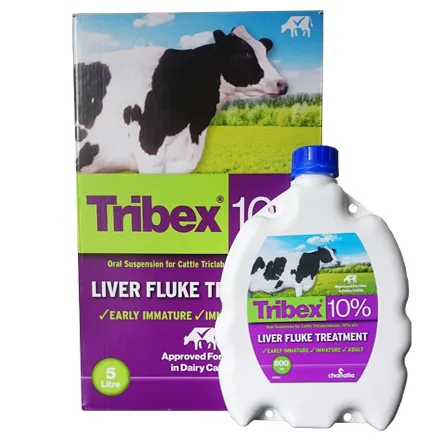
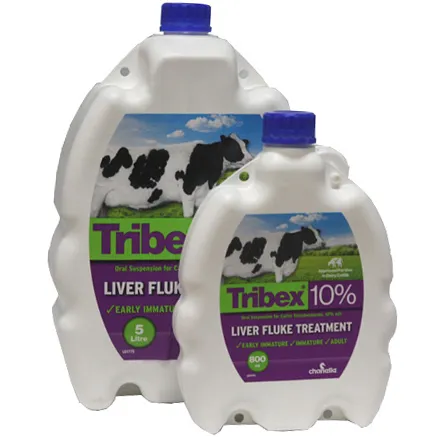
Tribex 10% Oral Drench for Cattle (Triclabendazole)
Tribex 10% Oral Suspension for Cattle is a liver fluke treatment containing triclabendazole 100 mg/ml. It is used for the treatment of acute, sub-acute and chronic fasciolosis caused by susceptible liver fluke (Fasciola hepatica) in cattle.
Tribex 10% targets early immature, immature and adult liver fluke, helping farmers manage liver fluke infections at different stages of development. Liver fluke can affect cattle health, growth rates, feed conversion and overall performance, making effective parasite control an important part of herd management.
Administered as an oral drench, Tribex 10% is suitable for cattle requiring treatment against triclabendazole-susceptible liver fluke. Available in 800ml, 2.2L and 5L sizes.
Product Information
| Tribex 10% Product Details | |
|---|---|
| Active Ingredient | Triclabendazole 100 mg/ml (10%) |
| Target Species | Cattle |
| Treats and Controls | Early immature, immature and adult liver fluke (Fasciola hepatica) susceptible to triclabendazole |
| Administration Method | Oral drench |
| Available Sizes | 800ml, 2.2L and 5L |
| Dosage | 6 ml per 50 kg bodyweight (12 mg triclabendazole/kg) |
Withdrawal Periods
| Species | Meat & Offal | Milk Withdrawal |
|---|---|---|
| Cattle | 56 days | Not permitted during lactation in animals producing milk for human consumption |
Important Milk Restrictions:
- Tribex 10% must not be used during lactation in animals producing milk for human consumption.
- When used in non-lactating cattle, milk for human consumption may only be taken from 84 hours after calving, subject to the restrictions below.
- The product is not intended for use within 41 days of calving.
- If calving occurs before 41 days after treatment, milk for human consumption may only be taken after 41 days plus 84 hours following treatment.
Important: The supplied SPC also states that the product is not permitted for use in pregnant animals intended to produce milk for human consumption. Confirm suitability with your veterinary practitioner before treating breeding dairy animals.
What Does Tribex 10% Treat?
Tribex 10% is specifically formulated to treat liver fluke infections in cattle caused by susceptible Fasciola hepatica. Unlike broad-spectrum wormers, its licensed indication is for liver fluke rather than gastrointestinal roundworms or lungworms.
Cattle - Liver Fluke Stages Treated
- Early Immature Liver Fluke: Targets early developing stages of susceptible Fasciola hepatica.
- Immature Liver Fluke: Treats developing liver fluke before they reach adulthood.
- Adult Liver Fluke: Treats mature liver fluke associated with chronic infection.
Types of Liver Fluke Infection
- Acute Fasciolosis: Infection associated with early immature liver fluke.
- Sub-Acute Fasciolosis: Infection involving developing immature liver fluke.
- Chronic Fasciolosis: Longer-established infection associated with adult liver fluke.
Note: Tribex 10% should only be used where the liver fluke population is susceptible to triclabendazole. Resistance may reduce treatment effectiveness.
Key Features of Tribex 10%
- Three-Stage Liver Fluke Treatment: Treats early immature, immature and adult liver fluke susceptible to triclabendazole.
- Active Ingredient: Contains triclabendazole 100 mg/ml.
- Acute and Chronic Infection: Licensed for treatment of acute, sub-acute and chronic fasciolosis in cattle.
- Oral Drench: Administered directly by mouth using suitable drenching equipment.
- Single-Dose Treatment: Recommended dose of 6 ml per 50 kg bodyweight.
- Farm-Specific Fluke Control: Can be incorporated into a veterinary-advised liver fluke management programme.
- Available Sizes: 800ml, 2.2L and 5L.
- Meat Withdrawal: 56 days for meat and offal.
Tribex 10% Dosage for Cattle
Recommended Dose: 6 ml per 50 kg bodyweight, equivalent to 12 mg triclabendazole per kg bodyweight.
Tribex 10% is administered orally as a single treatment using properly calibrated drenching equipment. Shake the container before use and determine the animal's bodyweight as accurately as possible.
Important: For cattle weighing over 400 kg, administer an additional 6 ml for every additional 50 kg bodyweight.
Cattle - Dose and Bottle Coverage
| Bodyweight | Dose Volume | 800ml | 2.2L | 5L |
|---|---|---|---|---|
| 50 kg | 6 ml | 133 | 366 | 833 |
| 100 kg | 12 ml | 66 | 183 | 416 |
| 150 kg | 18 ml | 44 | 122 | 277 |
| 200 kg | 24 ml | 33 | 91 | 208 |
| 250 kg | 30 ml | 26 | 73 | 166 |
| 300 kg | 36 ml | 22 | 61 | 138 |
| 350 kg | 42 ml | 19 | 52 | 119 |
| 400 kg | 48 ml | 16 | 45 | 104 |
| 450 kg | 54 ml | 14 | 40 | 92 |
| 500 kg | 60 ml | 13 | 36 | 83 |
| 550 kg | 66 ml | 12 | 33 | 75 |
| 600 kg | 72 ml | 11 | 30 | 69 |
Bottle Coverage: The 800ml, 2.2L and 5L columns show the number of complete doses available at each bodyweight, calculated by dividing the actual product volume by the required dose and rounding down to whole doses. Figures assume no product wastage.
Administration Instructions
- Oral Administration Only: Administer directly by mouth using suitable drenching equipment.
- Correct Dose: Give 6 ml per 50 kg bodyweight as a single administration.
- Shake Before Use: Shake the container thoroughly before administering.
- Accurate Bodyweight: Determine bodyweight as accurately as possible to avoid underdosing.
- Calibrated Equipment: Ensure the drenching gun or dosing equipment is correctly calibrated.
- Careful Administration: Avoid damaging the mouth or pharyngeal region when drenching.
- Equipment Hygiene: Clean drenching equipment before and after use.
- Original Product: Use the product unaltered from its original container.
- Resistance Management: Avoid unnecessary repeated use and seek veterinary advice when developing a treatment programme.
Liver Fluke Control and Treatment Planning
Liver fluke risk varies between farms depending on weather conditions, grazing management and the presence of wet or poorly drained land. The product data sheet provides guidance for treatment programmes in areas with different levels of liver fluke infection.
Areas of Heavy Liver Fluke Infection
- The SPC provides a guide of preventative treatment at approximately 10-week intervals from March/April through to October/November for cattle exposed to infected pasture.
- Where cattle remain outdoors over winter, an additional January treatment may be required.
- Animals grazing affected pasture should be included in the treatment programme.
- Newly purchased cattle should be assessed and treated as appropriate before joining the main herd.
Areas of Moderate Liver Fluke Infection
- The SPC provides guidance for treatment at approximately 10-week intervals during the fluke season, generally September to January/February.
- Additional preventative treatment in spring may help reduce pasture contamination later in the year.
- Newly purchased cattle should be assessed before introduction to the herd.
Housed Cattle
For cattle housed over winter, the SPC recommends a single treatment two weeks after housing.
Acute or Sub-Acute Liver Fluke Outbreaks
Where acute or sub-acute liver fluke infection is diagnosed, affected cattle should be treated promptly and veterinary advice sought regarding any further treatment.
Important: These are treatment programme guidelines from the supplied SPC, not a fixed dosing schedule for every farm. Repeated treatment can contribute to triclabendazole resistance. A farm-specific programme should be developed with veterinary advice and appropriate diagnostic testing.
How Cattle Contract Liver Fluke
Cattle become infected with liver fluke when grazing pasture contaminated with infective larvae known as metacercariae. These larvae are associated with the liver fluke life cycle, which involves freshwater snails and damp grazing environments.
Wet fields, poorly drained areas and ground surrounding drains or watercourses can increase the risk of exposure. Liver fluke infection is often associated with wetter periods of the year, particularly from late summer through winter, although risk varies with weather and farm conditions.
Farmers should consider grazing history, local fluke risk and veterinary advice when planning treatment.
Signs and Effects of Liver Fluke Infection in Cattle
Liver fluke infection can affect cattle performance without always producing obvious symptoms. Reduced growth rates, poor feed conversion and loss of condition may develop gradually, making infection difficult to identify without appropriate testing.
Young Stock - Signs of Liver Fluke Infection
- Reduced growth rates and poor weight gain.
- Poor feed conversion and reduced performance.
- Weakness and loss of condition.
- Reduced performance around weaning.
- In severe cases, anaemia and significant weight loss.
Breeding Stock - Signs of Liver Fluke Infection
- Reduced body condition and general performance.
- Lower fertility and reproductive performance.
- Reduced conception rates.
- Lower milk production in affected cows.
- Reduced sale weights in cull cows.
- Slower growth and development in replacement heifers.
Important: These symptoms can have several causes. Veterinary diagnosis and suitable testing are recommended before treatment.
Important Safety Information
- Target Species: For cattle only.
- Administration Route: Oral administration only.
- Hypersensitivity: Do not use in animals with known hypersensitivity to triclabendazole.
- Resistance: Use only against liver fluke strains susceptible to triclabendazole. Frequent or repeated use may encourage resistance.
- Pregnancy: The SPC states that the product is safe during pregnancy, but restrictions apply to animals intended to produce milk for human consumption.
- Milk Restrictions: Do not administer during lactation in animals producing milk for human consumption. Observe all restrictions relating to calving.
- Adverse Reactions: No known adverse reactions are listed in the supplied SPC.
- Protective Clothing: Wear gloves when handling or administering the product.
- Skin and Eye Contact: Wash splashes from skin and eyes immediately.
- Contaminated Clothing: Remove contaminated clothing immediately.
- After Handling: Wash hands and exposed skin after work and before meals.
- During Use: Do not eat, drink or smoke while handling the product.
- Allergy Precautions: People with known hypersensitivity or contact allergies should avoid direct skin contact and inhalation.
Storage and Shelf Life
- Shelf Life: 18 months when packaged for sale.
- Storage Temperature: Do not store above 25°C.
- Frost Protection: Protect from frost.
- Pack Sizes: 800ml, 2.2L and 5L.
- Disposal: Dispose of unused veterinary medicinal product and associated waste in accordance with local requirements.
- Marketing Authorisation Holder: Channelle Animal Health Ltd, 7 Rodney Street, Liverpool, L1 9HZ, England.
- Marketing Authorisation Number: VPA10879/013/002.
Important: Always read the product label and all enclosed information for Tribex 10% Oral Suspension for Cattle before administering. Follow veterinary advice and observe the specified withdrawal periods.
This product is only licensed for sale within the Republic of Ireland
Click here to Download Data Sheet
Summary of Product Characteristics
1 NAME OF THE VETERINARY MEDICINAL PRODUCT
Tribex 10% Oral Suspension for Cattle
2 QUALITATIVE AND QUANTITATIVE COMPOSITION
Each ml contains
Active substance:
Triclabendazole 100 mg
Excipient(s):
Methyl Parahydroxybenzoate (E2I8) 2.0 mg
Propyl Parahydroxybenzoate (E216) 0.2 mg
Carmoisine supra (EB122). 22.5 mg
For a full list of excipients, see section 6.1
3 PHARMACEUTICAL FORM
Oral suspension
An aqueous pink-coloured suspension
4 CLINICAL PARTICULARS
4.1 Target Species
Cattle
4.2 Indications for use, specifying the target species
The product is indicated for the treatment of acute, sub-acute and chronic fasciolosis in cattle caused by early immature, immature and adult stages of liverfluke (Fasciola hepatica) susceptible to triclabendazole.
4.3 Contraindications
Do not use in cases of known hypersensitivity to the active ingredient
4.4 Special warnings for each target species
None
4.5 Special precautions for use
Special precautions for use in animals.
Only use for liver fluke strains susceptible to triclabendazole. Frequent and repeated use may lead to the development of resistance. Care must be taken not to damage the mouth or pharyngeal region when dosing. Clean drenching equipment before and after use. Use unaltered product from the original container.
Special precautions to be taken by the person administering the veterinary medicinal product to animals.
When using the product do not eat, drink or smoke, Wear gloves. Wash splashes from eyes and skin immediately. Take off any contaminated clothing immediately. Wash hands and exposed skin before meals and after work.
In cases of hypersensitivity and contact allergy, direct skin contact and inhalation should be avoided.
4.6 Adverse reactions (frequency and seriousness)
None known
4.7 Use during pregnancy, lactation or lay
The product is safe for use during pregnancy. However, the product is not permitted for use in animals producing milk
for human consumption, including pregnant animals intended to produce milk for human consumption.
4.8 Interaction with other medicinal products and other forms of interaction
None known.
4.9 Amounts to be administered and administration route
For oral administration only, using properly calibrated dosing equipment.
Estimate bodyweight accurately.
Shake container before use.
Recommended dose rate: 12 mg triclabendazole per kg bodyweight as a single administration.
DOSAGE GUIDE:
For animals over 400 kg - give an additional 6 ml for each additional 50 kg bodyweight
DOSING PROGRAMME:
Routine treatment (Areas of heavy fluke infection)
As a guide, dose all cattle exposed to fluke infected pastures preventatively at regular intervals of 10 weeks from March/April through to October/November. In situations where stock are out-wintered, another dose in January may be required.
All animals grazing the pasture should be treated at these times.
All bought in animals should be dosed before joining the main flock.
Veterinary advice should be sought with regard to specific preventative dosing regimes.
Routine treatment (Areas of moderate fluke infection)
Dose all cattle on fluke infected pastures at intervals of 10 weeks throughout the fluke season, usually September to January/February.
An additional preventative treatment in the spring will assist in reducing the amount of new infestation on the pastures
in the following autumn.
All bought in animals should be dosed before joining the main herd.
In-wintered cattle
Where cattle are in-wintered, a single dose of the product should be given 2 weeks after housing.
Treatment of sub-acute and acute outbreaks
Affected cattle should be treated immediately after diagnosis and veterinary advice should be sought for subsequent dosing intervals. If a preventative fluke dosing programme is employed, the occurrence of acute fluke is greatly reduced.
4.10 Overdose (symptoms, emergency procedures, antidotes), if necessary
No adverse effects were reported following a 3-fold overdose in cattle.
A single dose of 200 mg/kg causes inappetence, transient weight loss and slight effects on motor activity and serum glucose lactate dehydrogenase (GLDH) in calves.
4.11Withdrawal Period(s)
Meat and offal: 56 days.
The product is not permitted for use during lactation in animals producing milk for human consumption.
When used innon-lactating cattle: Milk for human consumption may only be taken from 84 hours after calving.
Not intended for usewithin 41 days of calving.
If calving occurs before 41 days after treatment, milk for human consumption may only betaken after 41 days plus 84 hours after the treatment.
5 PHARMACOLOGICAL or IMMUNOLOGICAL PROPERTIES
Pharmacotherapeutic group:
Anthelmintics,
Benzimidazoles and related substances
ATC vet-code:
QP52ACOI
Bodyweight Dosage Bodyweight Dosage
Up to 50 kg 6ml
100 kg 12ml
150 kg 18ml
200 kg 24ml
250 kg 30ml
300 kg 36ml
350 kg 42ml
400 kg 48ml
5.1 Pharmacodynamic properties
Triclabendazole differs from other benzimidazoles in that it is a narrow spectrum anthelmintic.
The drug accumulates significantly in both immature and adult stages of Fasciola hepatica and stimulates the major routes of the parasite’s energy generating system, as demonstrated by glucose derived acetate and propionate formation.
However, under these conditions the parasite’s motility decreased, indicating that the drug is not associated with inhibition of the energy generating pathways.
Triclabendazole inhibits colchicine binding to microtubular proteins suggesting interference of the drug with microtubular structure and function.
The drug strongly inhibits the release of proteolytic enzymes in immature and adult parasites, a process
dependant on microtubular functions.
The precise molecular mode of action of this fasciolicidal drug remains to be elucidated.
5.2 Pharmacokinetic properties
After oral administration, triclabendazole is rapidly metabolised to its sulphoxide and sulphone metabolites.
The sulphoxide is thought to be the active moiety. In cattle the sulphoxide and sulphone metabolites reached a Cmax of approx. 13 microgram/ml and 26 microgram/ml at 18 and 48 hours, respectively.
The vast majority of orally administered triclabendazole is eliminated in faeces after 7 days. Urinary excretion is minimal.
6 PHARMACEUTICAL PARTICULARS
6.1 List of excipients
70% non-crystallising sorbitol, (E420)
Methyl hydroxybenzoate, (E218)
Propyl hydroxybenzoate, (E216)
Polysorbate 80 (E433)
Aluminium Magnesium silicate
Microcrystalline cellulose & carmellose sodium, (E460 and E466)
Carmoisine supra (E122)
Simethicone emulsion
Purified water
6.2 Incompatibilities
None known.
6.3 Shelf-life
Shelf life of the veterinary medicinal product as packaged for sale: 18 months
6.4 Special precautions for storage
Do not store above 25°C.
Protect from frost.
6.5 Nature and composition of immediate packaging
Pack sizes:
IL pack contains 0.8L of product,
2.5L pack contains 2.2L of product,
5L pack contains 5L of product
Container: High density polyethylene
Closure: Copolymer polypropylene with tamper evident seal
Cap Liner: Polyfaced Steran Wad
Spout: Polypropylene
Not all pack sizes may be marketed.
6.6 Special precautions for the disposal of unused veterinary medicinal products or waste materials
Any unused veterinary medicinal product or waste materials derived from such veterinary medicinal products should be disposed of in accordance with local requirements.
7 MARKETING AUTHORISATION HOLDER
Channelle Animal Health Ltd
7 Rodney Street
Liverpool
L1 9HZ
England
8 MARKETING AUTHORISATION NUMBER(S)
VPA 10879/013/002
9 DATE OF THE FIRST AUTHORISATION/RENEWAL OF THE AUTHORISATION
20th June 2007
10 DATE OF REVISION OF THE TEXT
29th April 2010
26th November 2010
Drench correctly
Cattle Oral drenches
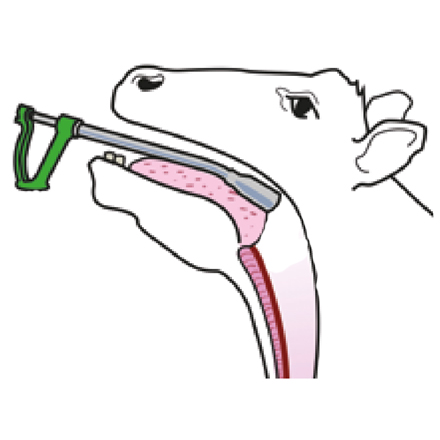
Oral drenching guns are designed to deliver the treatment towards the back of the mouth over the tongue, so the entire dose is swallowed at once to optimise efficacy.
• Make sure animals are properly restrained, with their head held up • Slide the nozzle of the dosing gun in the side of the mouth and over the tongue so that the entire dose is swallowed immediately
• Drenching equipment must be correctly calibrated and in good working order
• Calibrate the gun using the product just before treatment starts by delivering two or more doses into a graduated measuring cylinder Faulty equipment, or attempting to dose too quickly, may mean that the barrel of the gun does not fill properly or that the liquid is full of bubbles.
Dosing Weight – do not guess. Underestimating the weight of an animal is a common cause of underdosing. Select and weigh the biggest animal in the group to determine the correct dose. If there is a wide range of weights, consider splitting the group, then weigh the heaviest in each section. Do not forget to check that the weigh crate is accurate before starting!
Calibrate and maintain the drench gun
Always check the gun is delivering the right amount before you drench. Remove the plunger from a 10 ml syringe, put a thumb over the end and squirt the dose into it, making sure there are no air bubbles left. Adjust the gun until the dose delivered is correct. Drenching guns should also be well maintained and replaced regularly. Clean with warm soapy water after use and check springs and tubes to make sure there are no kinks that will form air bubbles.
Withholding food
Research has shown that the efficacy of the white (BZ) and clear (AV) drenches can be improved by withholding food for 12–24 hours before treatment. It is not advised to deprive heavily pregnant ewes of food, so if you treat this class of stock with anthelmintics, you may wish to use yellow drenches (LV) because their efficacy is less dependent on rumen fill.
Storage
Wormers should be stored securely, away from direct sunlight at 4–25°C. Check the use-by date and, once open, use within the time shown on the packaging. Shake white (BZ) products well before use.
Pharmacodynamics
Triclabendazole and its metabolites are active against both the immature and mature worms of Fasciola hepatica and Fasciola gigantica helminths.
Mechanism of action
Triclabendazole is an anthelmintic agent against Fasciola species.
The mechanism of action against Fasciola species is not fully understood at this time.
In vitro studies and animal studies suggest that triclabendazole and its active metabolites (sulfoxide and sulfone) are absorbed by the outer body covering of the immature and mature worms, causing a reduction in the resting membrane potential, the inhibition of tubulin function as well as protein and enzyme synthesis necessary for survival. These metabolic disturbances lead to an inhibition of motility, disruption of the worm outer surface, in addition to the inhibition of spermatogenesis and egg/embryonic cells.
A note on resistance
In vitro studies, in vivo studies, as well as case reports suggest a possibility for the development of resistance to triclabendazole.
The mechanism of resistance may be multifactorial and include changes in drug uptake/efflux mechanisms, target molecules, and changes in drug metabolism.
Tribex 10% is an oral drench for cattle that is used for the treatment and control of all three stages of liver fluke, mature, immature and early immature.
Active Ingredient: Triclabendazole
Target Species: Cattle
Treats and Controls: Mature, immature and early immature liver fluke
Withdrawal Time: 56 days for animals intended for meat and offal. The product is not permitted for use during lactation in animals producing milk for human consumption. When used in non-lactating cattle: Milk for human consumption may only be taken from 84 hours after calving. Not intended for use within 41 days of calving. If calving occurs before 41 days after treatment, milk for human consumption may only betaken after 41 days plus 84 hours after the treatment.
Legal Status: POM
Delivery Information
- Fast Nationwide Delivery (Ireland)
- Standard Delivery - orders under €129 are €6.99
- Free Shipping for orders over €129
- Typically 2-4 days for delivery
Note: Some products may have an extra heavy/bulk delivery charge; this will be noted on the product page.
Delivery Service
Here at Agridirect we have joined forces with An Post & DPD to ensure all packages are delivered promptly and safely to you. We ship to all mainland countries within the EU. Deliveries take place Monday to Friday, excluding bank holidays. Once your order has been dispatched from our warehouse, you will be notified by email. If there is a delay with your order for any reason, you will be contacted immediately.
Delivery Times
- Ireland (ROI & NI) - 2-4 Working Days
- EU (Mainland Only) - 4-6 Working Days
Some products have an extended delivery time, this is noted on the products.
Delivery Rates
- Country - Delivery Charge
- Ireland (ROI & NI) - €6.99
- Austria - €39.99
- Belgium - €36.99
- Czech Republic - €39.99
- Denmark - €39.99
- Finland - €51.99
- France - €36.99
- Germany - €36.99
- Hungary - €43.99
- Italy - €49.99
- Luxembourg - €36.99
- Netherlands - €36.99
- Poland - €36.99
- Portugal - €51.99
- Slovakia - €43.99
- Slovenia - €43.99
- Spain - €49.99
- Sweden - €49.99
A selection of the products we sell are only licensed for sale within the Republic Of Ireland and can not be shipped outside of the country. These products are noted as only being available within the Republic of Ireland on the individual product pages.
Note: There may be an additional charge on certain bulky items. This charge will be clearly marked on applicable products and will be explained on the checkout page before payment has been made.
Returns Policy
We’re sorry your purchase didn’t work out. But don’t worry; we have a great returns policy to help you out.
All purchases can be returned to us within 14 days of delivery, and returned goods must be received within 14 days from the date you informed us of the return.
Purchases may be opened for inspection but must not be used and must be repackaged securely in the original packaging if you wish to return it.
If we discover goods have been used or there has been a loss in value of the goods due to damage to the goods while in your care or whilst being returned to us, we will reduce the amount refunded, which may amount to the full cost of the product, to cover the loss of value of the goods.
All returns should be complete, which includes boxes, manuals, and accessories that may have been included with the order.
All returns must be packaged appropriately for shipping; we will not accept responsibility for damages or loss that occurs during shipping of a return product.
We accept no responsibility for goods damaged or lost while in transit to us.
How do I return a product?
We have partnered with DPD to make your returns process easy and secure. Simply follow the steps below and bring your package to an official DPD pickup point.
1) All returns must be accompanied with a fully filled out returns form which can be downloaded returns form PDF.
2) To print off your return label click DPD Returns page or visit www.dpd.ie/returns and follow the on-screen instructions. Make sure and use your order number as your reference.
- Select “Continue as Guest”
- Select “Agridirect” from the drop-down menu
- Select your reason for returning
- Select the size of the package you wish to return
- Accept DPD’s terms and conditions
- Fill in your payment details
- Fill in your own details
- Follow the instructions to print off your label
3) Bring your package to a DPD pickup point. To find your nearest drop off point DPD pickup shops.
Once the returned product has been received into our warehouse and been fully inspected a refund will be issued.
If you choose not to use the DPD returns service we recommend that you use a method that can be tracked.
For the return of bulk products please contact us at sales@agridirect.ie
I have received a damaged product from you, what should I do?
First off, if you have received a damaged electrical product from us, do not plug it in. Any electrical products that are plugged in are deemed ‘as used and accepted’ and are not accepted as returns. All damages must be reported to us via phone or email within 24hours of receipt of goods. Please ensure you check your items upon delivery.
How do I begin the returns process?
If you wish to begin the return process, please email us at sales@agridirect.ie and ensure the following information is included in your email. Your name, phone number, Order id, the item you wish to return, reason for return and if the product is damaged we require photos of the product.
Once you have sent us all required information a member of our team will assess your claim and will contact you as soon as possible. Please hold off on returning products until a member of our team has called you to confirm.
Refunds
Once the returned product has been returned to us and fully inspected a refund will be issued.
Please Note: A typical timeline for a refund to show in your account is up to 10 working days from the date processed, depending on your bank.